- The puck must cross the attacking blue line before any attacking player does.
- Skates decide it, not sticks. A player is onside if one skate is on the line or behind it when the puck crosses.
- When a team is offside, play stops and restarts with a faceoff outside the zone.
- A goal can be cancelled if video shows the attack was offside when it entered the zone.
Hockey is fast, and two of its rules stop the game more than any others. One is icing. The other is offside.
Offside looks confusing on television because it is judged in a fraction of a second. The idea behind it is simple.
Three zones, two blue lines
Two blue lines are painted across the ice. They split the rink into three parts. The end a team defends is its defending zone. The middle is the neutral zone. The far end, where it tries to score, is its attacking zone.
Offside is about one moment only: the moment the puck enters the attacking zone.
The rule in one sentence
The puck has to go in first.
If an attacking player crosses the blue line into the attacking zone before the puck does, his team is offside. An official called a linesman blows the whistle and play stops.
It is all about the skates
The linesman watches the players' skates. Sticks do not count. A player can reach his stick over the line as far as he likes.
A player is onside as long as one skate is on the blue line or behind it at the instant the puck crosses. Both skates have to be completely over the line for him to be offside.
The puck has its own test. It is not in the zone until all of it has crossed the line.
Onside or offside?
| Situation | Call |
|---|---|
| The puck crosses the line, then the player follows | Onside |
| Both of the player's skates are over the line before the puck | Offside |
| One skate is still on the line when the puck crosses | Onside |
| One skate is in the air above the line when the puck crosses | Onside |
| The player carrying the puck crosses the line backward, ahead of the puck | Onside |
| A defender brings the puck back into his own zone while attackers are there | Onside |
The fourth line of that table is recent. Until 2020 a skate had to be touching the ice. Players were being called offside because a foot had lifted an inch as they crossed. The NHL changed the rule so that a skate above the line counts.
The puck goes in first. Everything else about the rule is detail.
Delayed offside
Sometimes a player is in the zone too early but nobody on his team is touching the puck. The linesman does not blow the whistle. He raises his arm instead.
That is a delayed offside. The attackers can fix it by leaving the zone. Once every one of them has skated back to the blue line, the arm goes down and they can go in again. Fans call this tagging up.
If one of them touches the puck first, the whistle blows.
What happens after the whistle
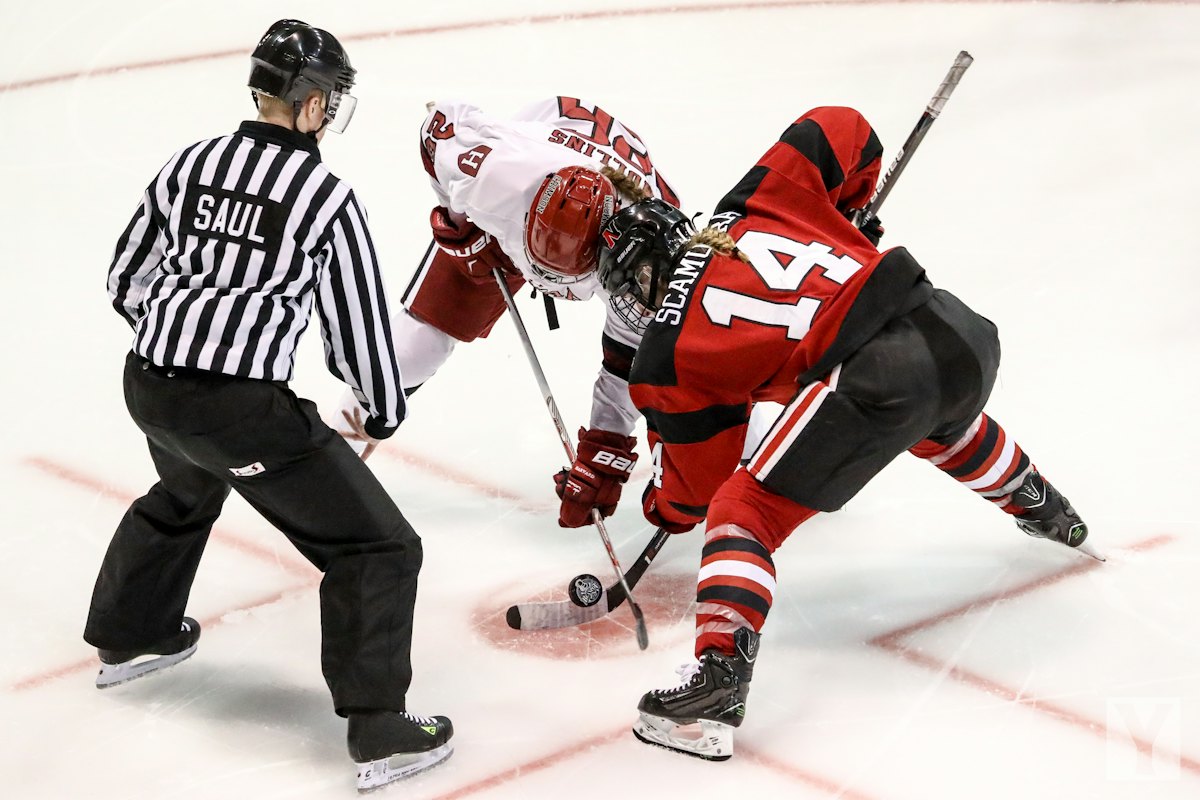
Play restarts with a faceoff, where an official drops the puck between two players. It is held just outside the zone, so the attacking team loses its position but not much else.
If the linesman decides a team went offside on purpose, the faceoff goes all the way back to that team's own end.
The video review
Since 2015 a coach can challenge a goal if he believes the other team was offside when it entered the zone. Officials look at the video, and if he is right the goal is cancelled, even if it was scored half a minute later.
It is a gamble. If the challenge fails, his team gets a two-minute penalty.
These reviews are the most argued-about part of the rule. Goals have been cancelled because a skate was a couple of inches offside, long before the puck went in.
Why the rule exists
Without offside, a team could leave a player standing next to the other goal all game, waiting for a long pass. The sport would turn into a contest of who could hit that pass.
The rule dates from 1929, when the NHL first allowed forward passes everywhere on the ice. It forces a team to move up the rink together.
The other whistle you will hear all night is explained in what icing is. And to follow the season, see where the points in the standings come from.