- A foul is illegal contact or bad behavior. A violation is a broken rule with no contact, such as traveling.
- A player is out of an NBA game after his sixth personal foul.
- From a team's fifth foul in a quarter, every foul it commits on defense sends the other team to the free throw line.
- Two technical fouls for bad behavior, or one flagrant 2, and a player is ejected.
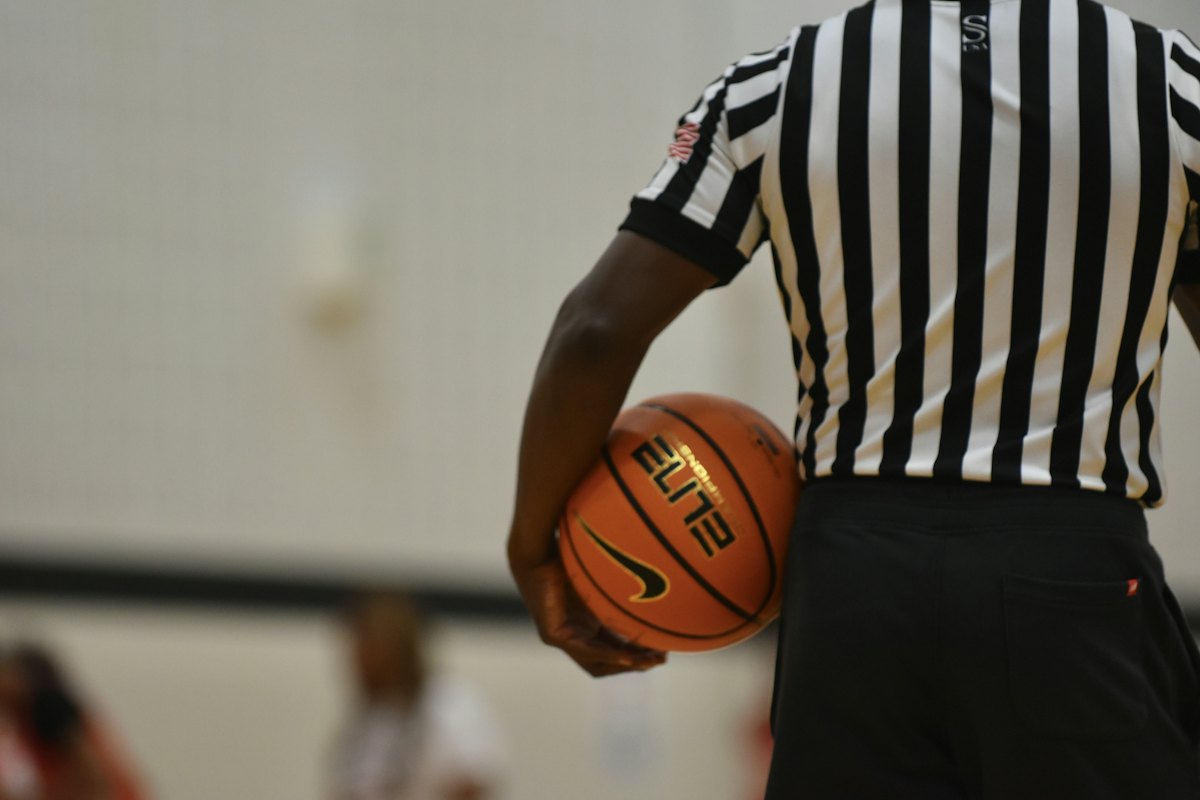
A basketball game is stopped by a whistle dozens of times. To a new viewer the whistles all sound the same, and the referee's hand signals do not help much.
They fall into two groups. Once you can tell a foul from a violation, most of what the referees do starts to make sense.
Fouls and violations are different things
A foul involves another person. One player hits, holds, pushes or blocks an opponent in a way the rules do not allow, or behaves badly. Fouls are counted against the player and against his team.
A violation involves only the ball or the clock. Nobody is touched. The team simply loses the ball, and nothing is added to anyone's count.
Personal fouls
The ordinary foul is called a personal foul. What happens next depends on what the fouled player was doing.
If he was shooting, he gets free throws: two for a normal shot, three if he was behind the three-point line. If the shot went in anyway, the basket counts and he gets one free throw on top.
If he was not shooting, his team usually just takes the ball out of bounds. And if the foul was committed by the team with the ball, such as a charge into a defender who was standing still, the ball goes to the other team with no free throws.
The two counts that matter
The first count is personal. A player who commits six fouls in an NBA game is finished for the night. That is why you see stars sit on the bench early when they pick up two or three quickly.
The second count belongs to the team. Each team may commit four fouls in a quarter at no extra cost. From the fifth one, every foul it commits on defense gives the other team two free throws, shooting or not. Announcers call this being "in the bonus" or "in the penalty". The count goes back to zero each quarter.
Fouls with a bigger price
| Foul | What it is | Penalty |
|---|---|---|
| Technical | Bad behavior: arguing, taunting, hanging on the rim | One free throw. Two in a game and the player is ejected |
| Flagrant 1 | Contact that was unnecessary | Two free throws and the ball |
| Flagrant 2 | Contact that was unnecessary and excessive | Two free throws, the ball, and an ejection |
| Clear path | Fouling a player who has an open run to the basket | Two free throws and the ball |
| Take foul | Grabbing a player only to stop a fast break | One free throw and the ball |
| Flop | Faking contact to fool the referee | One free throw |
The pattern is simple. The more a foul looks like a choice to break the rules, or the more dangerous it is, the more it costs.
A violation costs you the ball. A foul goes on your record.
Violations: the ball changes hands
| Violation | What happened |
|---|---|
| Traveling | Moving with the ball without dribbling it |
| Double dribble | Dribbling, stopping, then dribbling again, or dribbling with two hands |
| Shot clock | Failing to hit the rim with a shot within 24 seconds |
| Eight seconds | Taking more than 8 seconds to bring the ball past midcourt |
| Backcourt | Taking the ball back over midcourt once it has crossed |
| Three seconds | An attacking player standing in the painted area under the basket for more than 3 seconds |
| Five seconds | Taking more than 5 seconds to pass the ball in from out of bounds |
| Goaltending | Touching a shot on its way down or after it has hit the backboard |
Goaltending is the odd one. When the defense does it, the other team is simply given the points as if the shot had gone in.
Defenders have a three-second rule too. A defender cannot camp in the painted area unless he is guarding someone closely. Breaking that rule is punished with a technical foul and one free throw.
The coach's challenge
Each coach can ask for one call per game to be reviewed on video. He needs a timeout to do it. If the review proves him right, he keeps the timeout and gets a second challenge.
Only certain calls can be challenged: a foul called on his own player, an out-of-bounds decision, and goaltending.
Why teams foul on purpose
Late in a close game you will see the trailing team foul again and again. It is deliberate. A foul stops the clock, and two free throws can be missed. It is the only way to get the ball back quickly.
The rules push back a little. In the last two minutes, fouling a player who is nowhere near the ball gives the other team a free throw and the ball as well.
Now that you know the whistles, see how the NBA Play-In Tournament works, or find out why the hoop is 10 feet high.